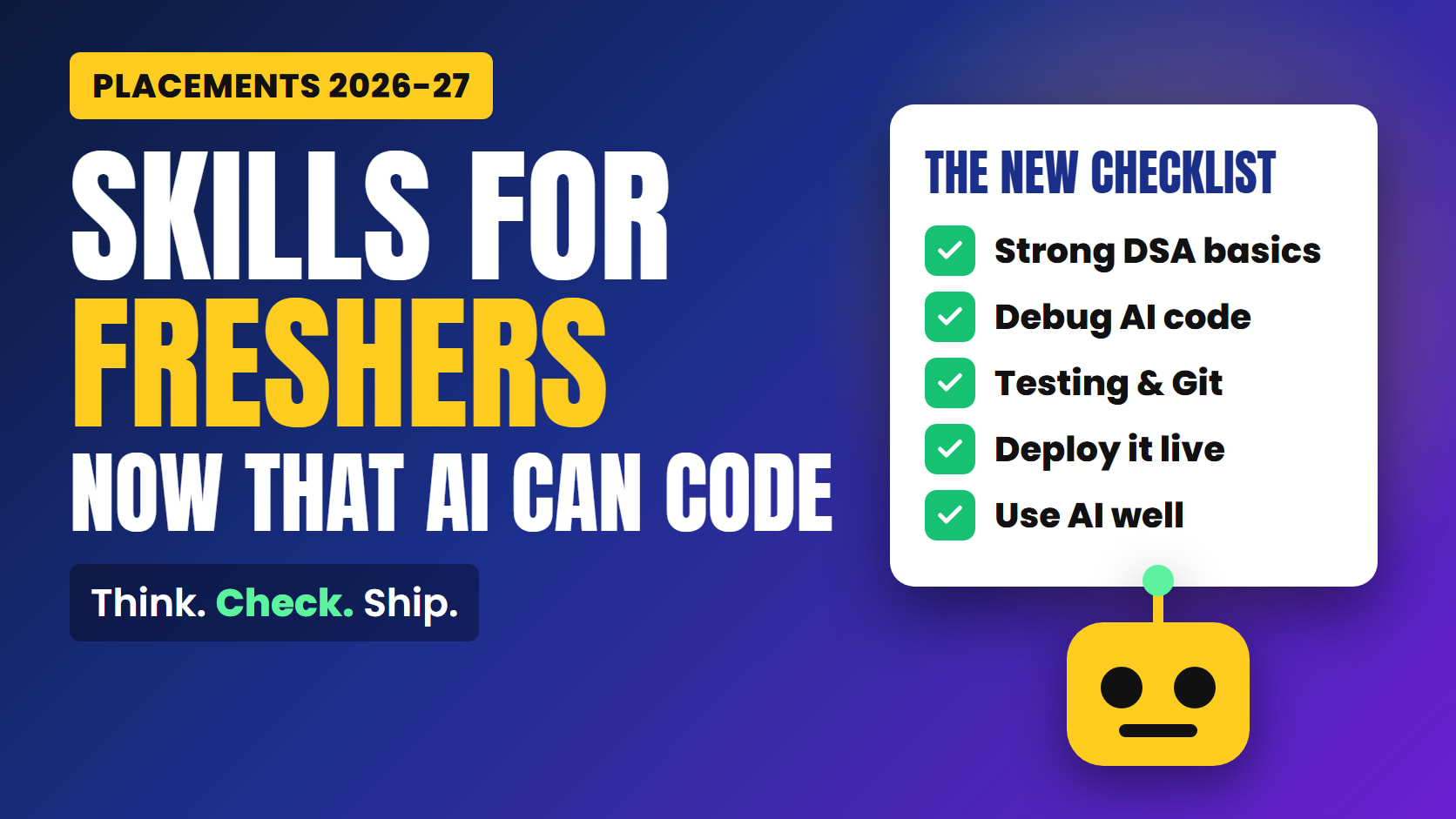
Skills for Freshers in 2026: What Companies Want Now That AI Can Code
A few years ago, the big placement question was simple: "Can you code?"
Today, AI tools can write a working function in seconds. So that question is not enough anymore.
The new question is: "Can you think, check and ship?" To ship means to put your work live. Can you solve the problem? Can you check the code, even when AI wrote it? Can you get it running for real users?
This is a checklist of the most important skills for freshers right now. It is written for Indian CS students preparing for placements. For each skill, you get why it matters and how to prove it.
At a glance: 10 skills for freshers in 2026
Skill | Why it matters now | How to show it |
|---|---|---|
Problem solving and DSA | AI writes code, but you must choose the right approach | Solve problems out loud in interviews |
Reading and debugging code | AI code is often "almost right" | Explain a bug you found and fixed |
System design basics | Someone must decide how the parts fit | Draw your project's design and explain it |
Testing | Tests prove the code really works | Tests in your GitHub projects |
Git and teamwork | All real work happens in teams | Clean commits, pull requests, open source |
Working with AI tools | Most developers already use them | Describe how you used and checked AI output |
Communication | You explain, ask and write every day | Good README files, clear interview answers |
Domain knowledge | AI does not know your users' real problems | A project for one real field, like banking |
Cloud and deployment basics | Code is only useful when it runs | A live link on your resume |
Learning fast | Tools change every year | A new tool you learned and used quickly |
What employers and reports actually say
This list is not a guess. Here is what recent surveys and reports found.
AI use is normal now. The Stack Overflow Developer Survey 2025 asked this. 84% of developers use or plan to use AI tools.
New coders start with AI. GitHub's Octoverse report (October 2025) has a clear finding. About 80% of new developers on GitHub use Copilot, GitHub's AI coding helper, in their first week.
But trust is low. In the same survey, 46% of developers do not trust AI answers to be correct. Only about 3% highly trust them.
Thinking still comes first. The World Economic Forum's Future of Jobs Report 2025 (January 2025) surveyed over 1,000 large employers worldwide. 69% of them called analytical thinking a core skill. That means breaking a problem into parts and reasoning about it. It was the top skill.
Skills now count as much as degrees. A Nasscom–Indeed report, India's AI Talent Inflection Point (covered in May 2026), has a key finding. About 40% of Indian employers prefer proven AI skills or certifications over degrees. Another 32% give skills and degrees equal weight (CXOToday).
Humans plus AI. An earlier Nasscom–Indeed study, Work Reimagined (January 2026), polled over 120 tech HR leaders. About 97% said that by 2027, humans will work alongside AI (news coverage).
The pattern is clear. AI is part of the job. But companies still need people who can think about, check and explain the work.
1. Problem solving and DSA fundamentals
DSA means Data Structures and Algorithms. It is the study of how to store data and solve problems step by step.
AI can write a sorting function. But it cannot always tell you which approach fits your problem. Time complexity means how fast your code runs as the input grows. If you do not understand it, you cannot spot a slow answer.
That is why most placement tests still have a coding round. Many also start with an aptitude test. Both test your thinking, not your typing.
For service companies, practise aptitude too: maths, logic and verbal questions.
Why it matters: analytical thinking is the top core skill in the WEF report above.
How to prove it: solve problems regularly and explain your approach out loud. Start with our coding problems and the DSA quizzes.
2. Reading and debugging code (including AI-written code)
Debugging means finding and fixing mistakes in code. In real jobs, you read much more code than you write.
AI makes this skill even more important. In the Stack Overflow 2025 survey, 66% of developers named one big frustration. It was AI answers that are "almost right, but not quite". About 45% said debugging AI code takes more time.
So the person who can find the hidden bug is very valuable.
How to prove it: in interviews, tell a short story about a bug you fixed. Say what broke, how you found it, and what you changed. Practise by taking AI-written code and checking it line by line.
3. System design basics
System design is planning how the parts of an app work together. For example: the frontend, the backend, the database and the APIs. An API is a set of rules that lets two programs talk to each other.
Freshers are not expected to design huge systems. But you should know the basics. What is a database index? It is a shortcut that makes searches faster. What is caching? It is saving results so you do not fetch them again. Why do we split an app into parts?
AI can write one file well. It is weaker at deciding how a whole product should fit together.
LinkedIn published its Skills on the Rise 2026 list in February 2026. In its list for Indian engineers, "Querying" is number 1. That means getting data out of databases. "API" is also in the top 10.
How to prove it: draw a simple diagram of your best project. Be ready to explain why you chose each part.
4. Testing
Testing means writing small checks that prove your code works. A unit test checks one small piece, like one function.
The Work Reimagined study expects more automation of boilerplate code and unit test creation. Boilerplate code is repeated, standard code. That does not make testing less important. Someone still has to decide what to test and judge if the tests are good.
Over half of the HR leaders also saw poor or incomplete AI output (Nasscom). Tests are how you catch it.
How to prove it: add tests to at least one GitHub project. In Python, start with pytest. Mention it on your resume.
5. Git and teamwork
Git is a tool that tracks every change to your code. GitHub is a website where people store and share Git projects.
Every software team uses some kind of version control. You will make branches. A branch is a separate copy of the code to work on. You will also open pull requests and review others' code. A pull request is a request to add your changes to the main code.
Teamwork matters too. "Collaboration" is in the top 10 of LinkedIn's 2026 list of rising engineering skills in India.
How to prove it: keep a GitHub profile with clear commit messages. A commit is a saved change in Git. Build one project with a friend using branches and pull requests. Even a small open-source fix counts.
6. Working with AI tools well
This is not about using AI to finish your assignment. It is about using it like a professional.
That means three things:
Prompting: asking clear questions with the right details, like the language, the input and the expected output.
Reviewing: reading every line before you use it.
Knowing the limits: AI can invent functions, miss edge cases and repeat old patterns. Edge cases are unusual inputs, like an empty list.
Most professionals are careful here. In the Stack Overflow 2025 survey, about 77% of developers said one thing clearly. "Vibe coding" is not part of their professional work. Vibe coding means accepting AI code without really reading it.
How to prove it: in an interview, describe one time AI gave you a wrong answer. Explain how you caught it. This shows good sense, which is exactly what employers want.
If you build apps, our article on AI agent skills for mobile developers goes deeper.
7. Communication
You will explain your code, ask questions, write updates and talk to clients. AI does not do this part for you.
Good communication is not about fancy English. It is about being clear. Short sentences. The main point first. Simple words.
In the Work Reimagined study, 98% of HR leaders said candidates need skills from more than one area. That means tech skills plus people skills.
How to prove it: write a clear README for each project. A README is the front page that explains what the project does and how to run it. In interviews, think out loud while solving.
8. Domain knowledge
Domain knowledge means understanding the field your software is for. Examples are banking, healthcare, retail or telecom.
AI can write code. But it does not know your users' real problems unless someone explains them. Know how a UPI payment or an insurance claim works. Then you can build better software for it.
The Nasscom–Indeed AI talent report says 63% of employers saw a rise in hiring for AI-related roles. BFSI (banking, financial services and insurance) and telecom led that rise.
How to prove it: pick one field you like. Build one project for it, such as an expense tracker or a clinic booking app. Read about how that industry works.
9. Cloud and deployment basics
Deployment means putting your app online so real people can use it. Cloud means using someone else's servers over the internet, like AWS, Azure or Google Cloud.
A project that runs only on your laptop is hard to show. A live link is easy to show.
The Nasscom–Indeed AI talent report lists skills in demand across industries. Two of them are connecting apps to the cloud, and MLOps and deployment. MLOps means the steps to deploy and run machine learning models.
How to prove it: deploy at least one project and put the live link on your resume. Learn basic Docker, a tool that packs your app so it runs the same everywhere. Many cloud platforms have free tiers. A free tier is a free plan with limits. Limits change, so check them before you start.
10. Learning fast
The tools you use in your first job may not have existed when you started college. That is normal now.
The WEF report has a big number. Employers expect about 39% of workers' current skills to change or become outdated by 2030. It also lists curiosity and lifelong learning as a skill rising in importance.
Learning fast is a skill you can practise. Read official docs. Build something small. Then explain it to someone else.
How to prove it: in interviews, share one example. "I learned X in two weeks and used it to build Y." This is one of the strongest answers a fresher can give.
How to prove these skills (without experience)
Freshers often say, "How can I show skills if I have no job yet?" Here are four honest ways.
Projects: two or three solid projects beat ten copied ones. Each should be deployed, tested and explained in a README.
GitHub: regular commits over months show steady work. Recruiters can see it in one click.
Internships: the Nasscom–Indeed AI talent report says internship postings in India rose 103% over three years. Apply early and widely.
Practice: regular coding practice keeps your basics sharp for tests. Use coding problems and topic quizzes a little every day.
Be honest about AI use in your projects. Saying "I used AI for the first draft, then fixed three bugs" sounds mature, not weak.
A 30-day plan
Use this plan next to your college work. About 1.5 to 2 hours a day is enough.
Days | What to do | What you will have |
|---|---|---|
Days 1–7 | Solve 2 DSA problems a day without AI. Do 20 minutes of aptitude practice a day. Set up Git and GitHub. Push all your solutions. | 14 solved problems and an active GitHub |
Days 8–14 | Start one project in a field you like. Use AI for help, but review every line. Keep 1 DSA problem a day. | A working first version of your project |
Days 15–21 | Add tests to the project. Find and fix at least 3 bugs. Learn basic system design ideas: database, cache, API. | A tested project and a simple design diagram |
Days 22–27 | Deploy the project. Write a clear README. Learn one new tool you have never used. | A live link and a strong README |
Days 28–30 | Update your resume. Practise explaining your project and one bug story out loud. Do a mock interview with a friend. | A resume and stories ready for interviews |
Is Python your main language? Our free Python tutorial covers the basics for this plan.
Final thoughts
AI has not removed the need for freshers. It has changed what a good fresher looks like.
Typing code is no longer the hard part. Thinking, checking and shipping are.
You do not need all 10 skills at an expert level. Get strong at DSA and debugging first. Then build one real project that is tested, deployed and well explained. That alone puts you ahead of many candidates.
Start today with one problem and one commit. 🚀
FAQ
What are the most important skills for freshers in 2026?
Problem solving and DSA, debugging, and working well with AI tools are the core. Add testing, Git, deployment and clear communication to stand out.
Is DSA still needed if AI can write code?
Yes. Most placement tests still have coding rounds. DSA also helps you judge if AI code is correct and fast enough.
Can I use AI tools for my projects?
Yes. Most developers now use AI tools. But you must understand every line. Be ready to explain the code and any bugs you fixed.
How many projects should a fresher have on their resume?
Two or three good projects are usually enough. Each should be live, tested and have a clear README.
Will AI replace fresher jobs in India?
No. But the work is changing. 97% of tech HR leaders expect humans to work alongside AI by 2027, says Work Reimagined. Freshers who can check and explain AI work will stand out.
Do companies care more about skills or degrees now?
Your degree still decides whether you can apply at many companies. But the Nasscom–Indeed AI talent report says 40% of employers prefer proven AI skills or certifications over degrees.