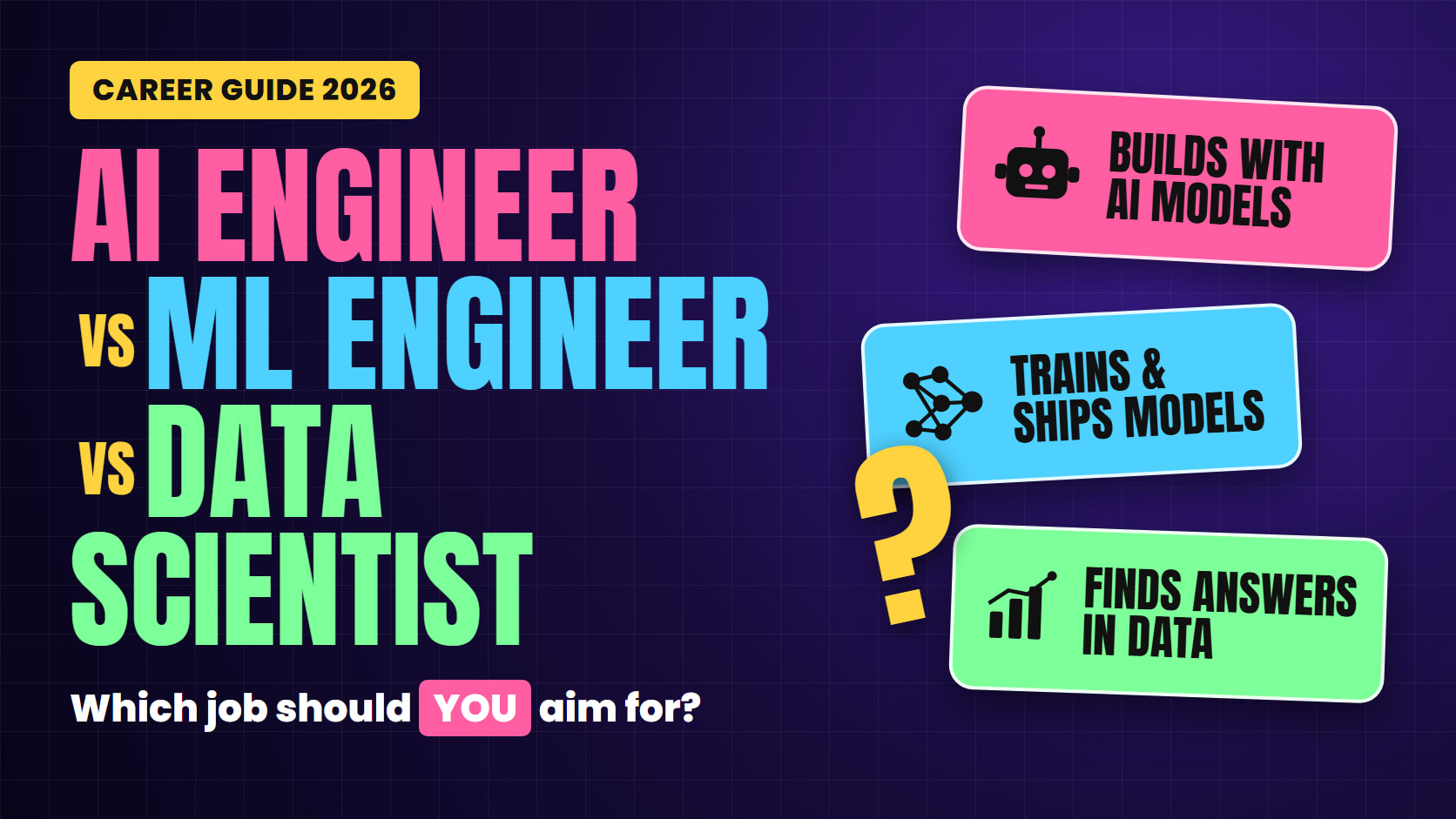
AI Engineer vs ML Engineer vs Data Scientist: Which Job Should You Aim For?
AI engineer, ML engineer, data scientist. Job posts use these titles as if they mean the same thing. They don't.
Pick the wrong one, and you may waste a year. You may learn skills the job rarely uses.
Demand for all three is real. In September 2026, AI and ML hiring on Naukri rose 20% from a year earlier. That was the highest growth of any major sector. Overall hiring grew just 2%.
This guide compares AI engineer vs ML engineer vs data scientist in plain words. You will see what each person does all day and what to learn. You will also see pay in India and a 6-month plan for each role.
At a glance: AI engineer vs ML engineer vs data scientist
Here is the short version. Read this table first, then jump to the role you care about.
AI engineer | ML engineer | Data scientist | |
|---|---|---|---|
Day-to-day work | Builds apps and features on top of ready-made AI models, like chatbots and agents | Trains models and puts them into real products that run reliably | Studies data to answer business questions and builds prediction models |
Main tools | Python, model APIs, LangChain, MCP, vector databases (to search text by meaning) | Python, PyTorch, scikit-learn, MLflow, Docker, cloud | Python, SQL, pandas, scikit-learn, charts and dashboards |
Maths needed | Low to medium | Medium to high | High in statistics |
Coding level | High (software engineering) | High (software plus ML) | Medium (scripts and notebooks) |
Typical background | Software or web developers | CS grads strong in both coding and ML | CS, maths, statistics or economics grads |
Fresher entry | Possible from web or backend roles | Hard; often via an SDE job first | Often via a data analyst job first |
Where the demand is | Companies adding AI features to their products | Product companies with large-scale ML systems | Banks, e-commerce, consulting, analytics firms |
In one line: the data scientist finds answers. The ML engineer builds models into products. The AI engineer builds products with existing models.
Role 1: Data scientist
A data scientist turns raw data into decisions. The question usually comes from the business. For example: "Why did sales drop last month?"
The work has three parts. First, clean the data. Second, find patterns with statistics. Third, explain the answer to people who are not technical.
Sometimes they also build a model. A model is a program that learns patterns from past data to predict something new.
A day in the job
Priya works at a food delivery company. In the morning, she writes SQL to pull last month's orders. She finds that many users cancel when delivery time goes above 40 minutes.
After lunch, she runs an A/B test. That means half the users see one version and half see another. Then she checks which version did better.
In the evening, she makes a few charts. She presents them to the product manager in a short meeting.
Best for: curious people who like numbers, asking "why", and explaining findings clearly.
Role 2: ML engineer
An ML engineer makes models work in the real world. A model in a notebook is just an experiment. A model inside an app must be fast, stable and up to date.
So the ML engineer trains models, tests them, and deploys them. Deploy means putting the model on a server so the app can use it.
They also watch the model after launch. Data changes over time, and a good model can slowly get worse. This problem is called model drift.
A day in the job
Arjun works at an online shopping app. He owns the "recommended for you" model.
In the morning, he sees that click rates dropped this week. He checks the data pipeline, the system that feeds data to the model. He finds a broken input column.
After fixing it, he retrains the model with PyTorch. He logs the results in MLflow and compares them with the old version.
The new model is better. He packs it in a Docker container and releases it to 5% of users first.
Best for: strong coders who also enjoy the maths behind ML and like building systems.
Role 3: AI engineer
This is the newest of the three titles. An AI engineer usually does not train big models from scratch. Instead, they use large language models (LLMs) through an API.
An LLM is a large AI model that reads and writes text. ChatGPT and Claude run on LLMs. An API lets your code send a request and get an answer.
The AI engineer connects these models to the company's data and tools. They build chatbots, search features, and agents. An agent is an AI program that takes steps on its own. For example, it can use tools.
A day in the job
Sana works at a startup that sells online software. She is building a support assistant that answers customer questions.
In the morning, she tests 50 real customer questions. The bot gets 8 of them wrong.
She finds the cause. The bot cannot find the right help article. So she improves the search step that feeds articles to the model.
In the afternoon, she connects the bot to the order system using MCP. MCP is an open standard for connecting AI apps to outside tools and data.
Best for: developers who love building products and want to ship AI features fast.
Skills and tools for each role
All three roles start with Python. After that, the paths split. Here are the main tools, as of November 2026.
Data scientist toolkit
SQL: to pull data from databases. You will use it every day.
pandas: a Python library to clean and shape table data.
scikit-learn: a library for classic ML models like regression and decision trees.
Statistics: averages, A/B tests, and tests that check if a result is real or luck.
Charts and dashboards: matplotlib, or a tool like Power BI or Tableau.
ML engineer toolkit
PyTorch: a popular library for building and training deep learning models.
scikit-learn: for baseline models, which are simple first models to compare against.
MLflow: an open-source platform to track experiments and manage models.
Docker and cloud basics: to package models and run them on servers.
Data structures and algorithms: ML engineer interviews can include coding rounds.
AI engineer toolkit
LLM APIs: how to send prompts, read replies, and control cost.
LangChain and LangSmith: LangChain is a free, open-source tool to build agents. LangSmith helps you test and watch them.
Hugging Face Transformers: a library to run and fine-tune open models.
RAG: short for retrieval-augmented generation. The app first finds the right documents, then the model answers using them.
Evaluation: testing AI answers with real examples, so you know when the bot is wrong.
Web basics: APIs, a backend framework, and Git.
Why it matters: tools change fast in AI. Learn the idea behind each tool, not just its buttons.
Salary in India (as of November 2026)
We could only find a few public sources that share their data openly. The figures below come from PayScale India and Indeed India. PayScale figures are reported by employees. Indeed figures are base pay from job posts in the last 36 months. Total pay includes bonus. Base pay does not. They are averages, not promises.
Pay varies a lot by company, city and skill. A product company in Bengaluru may pay far more than an average. A small firm in a smaller city may pay less.
Role | Fresher, under 1 year (total pay) | Mid-level | Typical range, all levels (base pay in job posts) |
|---|---|---|---|
Data scientist | About ₹5.95 lakh a year, total pay (PayScale, 307 salaries) | About ₹10 lakh total pay at 1–4 years (PayScale). Mid-career base in Bengaluru only: about ₹17.6 lakh (PayScale, 121 profiles, data from August 2025) | About ₹6.9 lakh to ₹21 lakh, average ₹12 lakh (Indeed, 295 salaries) |
ML engineer | About ₹5.96 lakh a year, total pay (PayScale, 39 salaries) | About ₹8.4 lakh total pay at 1–4 years (PayScale). Mid-career base, all-India: about ₹20.6 lakh (PayScale, 67 profiles) | About ₹6.2 lakh to ₹20 lakh, average ₹11.1 lakh (Indeed, 50 salaries) |
AI engineer | About ₹6.5 lakh a year, but from only 9 salaries (PayScale, "AI Software Engineer") | About ₹17.5 lakh base, mid-career, all-India (PayScale, sample size not shown) | "AI Developer" title: ₹5.7–19.3 lakh, average ₹10.5 lakh (Indeed, 54 salaries) |
Average base pay is close for all three. On PayScale India, it is about ₹10 lakh for each role. Data scientist: ₹10.1 lakh (1,122 profiles). ML engineer: ₹10.2 lakh (232 profiles). AI software engineer: ₹10.1 lakh (42 profiles).
Read the AI engineer row with care. The title is new, so salary sites have very little data for it. Indeed India does not show a separate "AI Engineer" figure. It shows "AI Developer" instead.
Few companies hire freshers straight into data scientist or ML engineer roles. Many people start as data analysts or software developers, then move across.
Our honest take: starting pay looks similar for all three roles in this data. Skills and the type of company matter more than the job title.
Which one fits you?
Use these simple checks. Pick the one where you nod the most.
Choose data scientist if…
You enjoyed statistics and probability in college.
You like asking "why did this happen?"
You are comfortable explaining results to non-technical people.
You are fine with less pure coding and more analysis.
Choose ML engineer if…
You are a strong coder and also like linear algebra and calculus.
You enjoy making systems fast and reliable.
You are ready for a longer learning path before your first job.
Choose AI engineer if…
You already build web or backend projects.
You want to ship a working product quickly.
You like trying new tools and are fine with them changing often.
Still unsure? Start as a solid Python developer. All three paths begin there, so no time is wasted.
Your first 6 months: a roadmap for each role
This plan assumes about 10–12 hours a week next to college. Build one small project every month. Put each one on GitHub.
Month | Data scientist | ML engineer | AI engineer |
|---|---|---|---|
1 | Python basics and SQL | Python basics and DSA practice | Python basics, Git, and how APIs work |
2 | pandas and charts. Analyse one public dataset | NumPy, pandas, and maths revision (vectors, derivatives) | Build a small backend API, for example with FastAPI |
3 | Statistics: A/B tests and tests that check if a result is real or luck | scikit-learn: regression, trees, model evaluation | Call an LLM API. Learn prompts, tokens (small pieces of text the model counts) and cost |
4 | scikit-learn models and how to judge them | PyTorch basics. Train a small neural network (a model made of layers, used in deep learning) | Build a RAG app that answers from your own notes |
5 | A dashboard in Power BI or Tableau | Track runs in MLflow. Package a model with Docker | Add tools to make an agent. Try MCP |
6 | End-to-end project with a written report | Deploy a model as a live API and monitor it | Add evaluation tests and deploy the app publicly |
For month 1, our free Python tutorial covers the basics. Then test yourself with the Python quizzes. If you choose ML engineering, add daily practice from our coding problems.
Common mistakes students make when picking
Choosing by title, not by work. "AI engineer" sounds exciting. But if you dislike backend coding, you may not enjoy it.
Collecting certificates instead of projects. A recruiter learns more from one working project than from five course badges.
Skipping the basics. Jumping to LLMs without Python, SQL or statistics leaves big gaps. Interviews find those gaps fast.
Ignoring DSA. Many engineering interviews still have coding rounds. This is true even for ML and AI roles. Our DSA quizzes help you prepare.
Copying a tutorial and calling it a project. Change the dataset, add a feature, and write what you learned.
Expecting a top salary at once. Most freshers start near the averages above. Pay grows with skill and results.
Final thoughts
There is no "best" role among the three. There is only the role that fits how you like to work.
If you like questions and numbers, try data science. If you like systems and maths, try ML engineering. If you like building products, try AI engineering.
What to do next: pick one role for the next 6 months. Follow the roadmap table above. Build six small projects. Then review whether you enjoy the work, and adjust.
When you start applying, our placement kit can help with interview prep. But your projects will matter most.
FAQ
Can a fresher get an AI engineer, ML engineer or data scientist job?
Yes, but it is not easy. Salary sites do report fresher pay for all three, so freshers are being hired. Strong projects and good basics improve your chances a lot.
Do I need a master's degree?
Not always. A 2026 Nasscom–Indeed report, "India's AI Talent Inflection Point", asked employers. 40% said they prefer proven AI skills or certificates over degrees. Research-heavy roles are different. They often ask for a master's or PhD.
Which role needs the most maths?
Data scientists need the most statistics. ML engineers need the most linear algebra and calculus. AI engineers need the least maths, but more software skills.
Is the AI engineer role just a trend?
The title is new, but the demand is real. By January 2026, about 14% of job posts in India mentioned AI, says the Nasscom–Indeed report. The core skills, coding and testing, stay useful even if titles change.
Which is best for freshers in India?
It depends on what you already do well. If you build web or backend apps, AI engineering is the shortest step. If you like statistics, start as a data analyst and grow into data science. ML engineering is usually easier after some time as a software developer.
Which role pays the most?
In the data we checked, pay is close for all three. Average base pay on PayScale is about ₹10 lakh for each role. Company and city matter more than the title.